
Medical Titanium Bar vs. Plate vs. Wire: Buyer Checklist
Medical Titanium Bar vs. Plate vs. Wire: A Comparison Guide for Implant Buyers
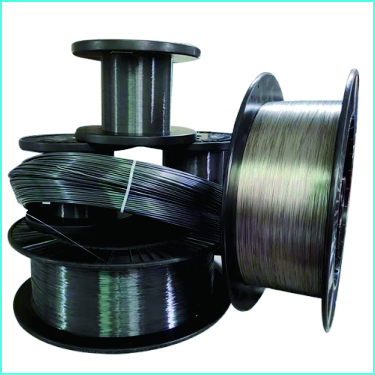
Medical titanium wire is one of three implant-grade forms a buyer must specify separately — wire, bar and plate carry different dimensional and inspection criteria.
A medical titanium bar, a medical titanium plate and a medical titanium wire can be produced from the same GR23 (Ti-6Al-4V ELI) heat and still fail a buyer's qualification for completely different reasons. Bar is judged on diameter tolerance, straightness and microstructure. Plate is judged on thickness range and rolling condition. Wire is judged on diameter consistency, surface finish and coil weight. The form you choose decides which questions actually matter in the RFQ.
This comparison sets the three forms side by side on the criteria a procurement or engineering team really specifies: grade, standard, size range, tolerance, surface condition and documentation. It also marks the boundary where Nitinol wire or Nitinol plate, made of Nickel-Titanium alloy under ASTM F2063, becomes the better answer — and the boundary where it does not.
Problem Definition: 'Medical Grade' Is Not a Specification
The most common sourcing error in implant materials is treating 'medical grade titanium' as a complete requirement. It is not. It leaves three variables open, and each one changes price, lead time and qualification risk.
- Grade is open. Commercially pure grades (GR1, GR2, GR3, GR4) and alloy grades (GR5, GR5 ELI, Ti 6AL4V ELI, GR23) behave very differently in strength and in machining. A supplier quoting 'medical titanium' without a grade is quoting an unknown.
- Standard is open. ASTM F67 covers unalloyed titanium for surgical implants, while ASTM F136 covers Ti-6Al-4V ELI for high-strength, load-bearing implants. These are not interchangeable documents, and a certificate issued to one does not satisfy the other.
- Form-specific attributes are open. Thickness range matters for plate, diameter tolerance and surface finish matter for wire, diameter plus microstructure and straightness matter for bar. A single generic data sheet cannot cover all three.
A fourth gap appears after the order: company-level certification is not lot-level evidence. An ISO 13485 certificate describes a quality management system. It does not by itself prove that a specific heat of GR23 bar met the chemical, mechanical and microstructural requirements of the purchase order. Buyers need both, and the second one arrives as a batch inspection certificate.
Industry Background: Where Demand and Supply Risk Sit
Bar and rod remain the volume centre of the medical titanium business. A 2026 market synthesis published via Hontitan, drawing on MarketsandMarkets data, placed titanium bar and rod at 52.4% of medical titanium component revenue in 2025. The same analysis identified the medical segment as the fastest-growing application in the titanium metal value chain, at a 6.15% CAGR through 2031.
Supply is concentrated. The same synthesis estimated that China controls approximately 75% of global titanium metal production, which is a continuity consideration for any Western device maker building a dual-source strategy. Upstream cost signals are visible but limited: grade 0 titanium sponge in China was reported at roughly USD 6.75/kg in July 2026. That figure describes sponge, not finished implant-grade mill product, and it should not be used as a proxy for bar, plate or wire pricing.
Regulation is moving at the same time. The US FDA recognised-standards record shows ASTM F67-24 for unalloyed titanium superseding recognition of the F67-13 edition, with a stated transition date of 22 December 2025. ISO 5832-2:2018 defines the characteristics and test methods for unalloyed titanium used in the manufacture of surgical implants. On the Nitinol side, the medical device market for nickel-titanium was projected at USD 3.14 billion for 2026, and FDA guidance for bone anchors references ASTM F2063 as the applicable material standard for wrought nickel-titanium shape-memory alloys.
How the Three Titanium Forms Compare at Specification Level
XI'AN BOSSIN METAL TECHNOLOGY CO., LTD. is a manufacturer of titanium and Nitinol semi-finished materials based in the Baoji High-tech Zone in China, producing titanium bar, medical titanium bar, titanium plate, titanium wire, titanium coil, Nitinol wire and titanium cable, with medical-grade titanium bar and Nitinol wire as its stated focus. The specifications below are drawn from its published product data and are used here as a concrete reference set for the comparison.
1. Medical Titanium Bar
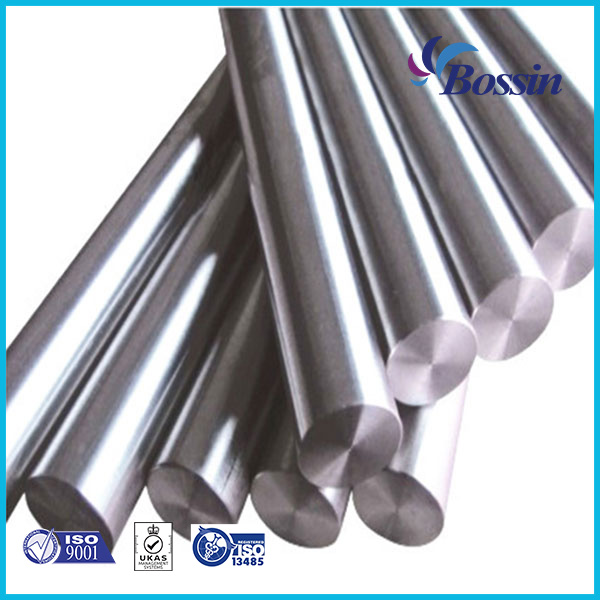
Medical titanium bar: solid round section, supplied to diameter tolerance classes h6–h9 for machining into screws, stems and dental components.
Bar is a solid mill product intended for stock-removal machining. Its commercial value sits in dimensional accuracy and in a controlled microstructure that survives turning, milling and thread rolling without cracking.
- Grades listed: GR1, GR2, GR3, GR4, GR5 ELI, Ti 6AL4V ELI, GR23.
- Standards listed: ASTM F136, ISO 5832-3, ASTM F67, ISO 5832-2.
- Size range: diameter 1.0–100 mm, length up to 6000 mm.
- Accuracy: h6, h7, h8, h9 tolerance classes, with machining tolerance stated at 0.005 mm.
- Microstructure: assessed against ETTC-2, classes A1–A3.
Bar is also the only one of the three forms where buyers can order directly against a device family. BOSSIN publishes dedicated diameter groupings for common implant programmes: bone screws at Φ3.5, Φ4.0, Φ4.5, Φ5.0, Φ5.5, Φ6.0, Φ8.0 and Φ10.0 mm; spinal components at Φ13.5, Φ14.0, Φ14.2, Φ15.0, Φ16.0 and Φ17.0 mm; bone joint stems at Φ30.0, Φ35.0, Φ40.0, Φ50.0, Φ55.0, Φ60.0 and Φ65.0 mm; dental implants at Φ3.0–20.0 mm. Ordering inside a published grouping shortens the drawing review, because the mill already runs that diameter.
2. Medical Titanium Plate
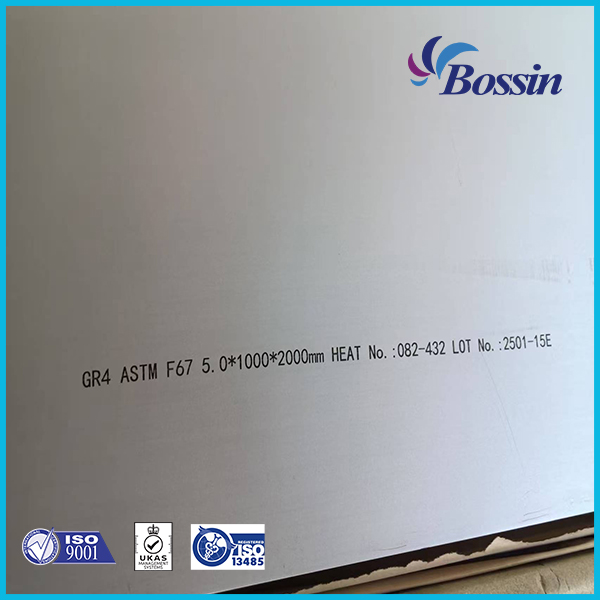
Medical titanium plate: flat rolled stock from 0.3 mm to 50.0 mm thickness, used for bone plates, stent precursors and joint components.
Plate is a flat rolled product. The buying decision turns on thickness range, width and length format, and whether the material is hot rolled or cold rolled — because that determines flatness, surface condition and how much finishing the device maker must add.
- Grades listed: GR1, GR2, GR4, GR5 ELI, Ti 6AL4V ELI, GR23.
- Standards listed: ASTM F136, ISO 5832-3, ASTM F67, ISO 5832-2.
- Size format: thickness 0.3–50.0 mm, width 100 mm, length 2000 mm.
- Process route: hot rolled and cold rolled.
- Typical device fit: surgical implants, bone plates, coronary stents, artificial joints.
The 0.3–50.0 mm thickness band is wide by design. Thin cold-rolled stock serves bone plates and stent precursors where surface quality and thickness consistency dominate; thick plate serves joint and instrument components where section stiffness matters more. A buyer who specifies only 'plate' without a thickness band and a rolling route is effectively asking the supplier to choose the process — and the process choice will be visible in the finish.
3. Medical Titanium Wire
Wire is a drawn small section. Unlike bar and plate, its acceptance criteria are dominated by diameter consistency across the length of a coil, surface integrity, and the weight and packaging of each spool.
- Grades listed: GR1, GR2, GR4, GR5 ELI, GR23.
- Standards listed: ASTM F67, ASTM F136.
- Size range: diameter 0.03–6.0 mm.
- Surface finish: polished or pickling.
- Packaging: 10–100 kg per coil or spool.
- Typical device fit: medical and orthopedic implants, surgical sutures, 3D printing feedstock.
Because the diameter range reaches down to 0.03 mm, surface condition becomes a functional requirement rather than a cosmetic one. Polished wire is normally specified where the wire contacts tissue or passes through a catheter lumen; pickled wire is often acceptable where the wire is subsequently formed, cut or overmoulded. Specifying the finish at RFQ stage avoids a second processing step later.
4. When Nitinol Wire or Nitinol Plate Is the Alternative
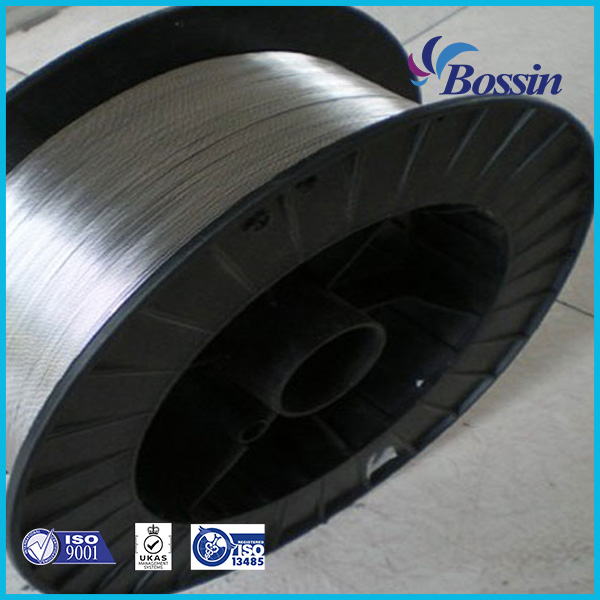
Nitinol wire: Nickel-Titanium alloy to ASTM F2063, supplied from 0.0127 mm to 6.0 mm in superelastic or shape-memory conditions.
Titanium and Nitinol solve different problems. Titanium is chosen for biocompatible structural support with a modulus closer to bone. Nitinol — a Nickel-Titanium alloy with nickel at 54.5–57.0% and titanium at 44% — is chosen when the device needs superelasticity or shape memory rather than rigid support.
- Nitinol wire: ASTM F2063; diameter 0.0127–6.0 mm; conditions include superelastic, shape memory, low-temperature superelastic, narrow hysteresis and wide hysteresis; surface finishes include polished bright, black oxide, acid pickled and light oxide. Transformation temperature options span ranges such as below −15 °C, −10 to 10 °C, 0 to 30 °C, 20 to 40 °C, 45 to 90 °C and 33 ± 3 °C.
- Nitinol plate: ASTM F2063; thickness 0.5–10 mm, width customer-specified; polished bright surface; transformation temperature ranges including −20 to 40 °C, 45 to 100 °C, −5 to 15 °C and 0 to −40 °C.
- Typical device fit: guide wires, dental root canal files, orthodontic archwires, cardiac occluders, thrombus filters, anchor pins, localisation wires, luminal stents and stone retrieval baskets.
The qualification burden also differs. FDA guidance for bone-anchor submissions references ASTM F2063 as the applicable material standard and recommends reporting the As and Af transition temperatures of the finished device using samples from multiple production lots. FDA separately lists ASTM F2516-22 as the recognised tension-test method for superelastic nickel-titanium, recommends ASTM F2129 pitting-corrosion testing where applicable, and points to ISO 10993-1 as the biological-evaluation framework. In practical terms, a Nitinol purchase order needs a transformation-temperature specification and a lot-sampling plan that a titanium order does not. Nitinol is therefore not a drop-in substitute for titanium bar, plate or wire: it is a different material with a different acceptance package.
Comparison Table: Bar vs. Plate vs. Wire
| Criterion | Medical Titanium Bar | Medical Titanium Plate | Medical Titanium Wire |
|---|---|---|---|
| Material family | Unalloyed and Ti-6Al-4V ELI titanium | Unalloyed and Ti-6Al-4V ELI titanium | Unalloyed and Ti-6Al-4V ELI titanium |
| Grades listed | GR1, GR2, GR3, GR4, GR5 ELI, Ti 6AL4V ELI, GR23 | GR1, GR2, GR4, GR5 ELI, Ti 6AL4V ELI, GR23 | GR1, GR2, GR4, GR5 ELI, GR23 |
| Standards listed | ASTM F136, ISO 5832-3, ASTM F67, ISO 5832-2 | ASTM F136, ISO 5832-3, ASTM F67, ISO 5832-2 | ASTM F67, ASTM F136 |
| Size range | Diameter 1.0–100 mm, length ≤6000 mm | Thickness 0.3–50.0 mm, width 100 mm, length 2000 mm | Diameter 0.03–6.0 mm |
| Tolerance / accuracy | h6, h7, h8, h9; 0.005 mm machining tolerance | Thickness band controlled by hot or cold rolling route | Diameter consistency across coil length |
| Surface / condition | Solid bar; microstructure to ETTC-2 A1–A3 | Hot rolled or cold rolled | Polished or pickling |
| Packaging | Cut lengths to order | Plate format 100 × 2000 mm | 10–100 kg per coil or spool |
| Typical implant use | Bone screws, spinal components, joint stems, dental implants | Bone plates, coronary stents, artificial joints | Surgical sutures, orthopedic implants, 3D printing |
| Main qualification risk | Microstructure and straightness after machining | Thickness consistency and flatness | Diameter drift and surface defects |
Step-by-Step: Matching Form Factor to Application
The checklist below is the sequence that keeps a sourcing project from being re-quoted three times. It works for any supplier; the reference values are the BOSSIN ranges used above.
- Fix the finished geometry first. Decide whether the device is machined from solid stock, cut and formed from flat stock, or drawn into a small section. This single decision eliminates two of the three forms before any grade discussion begins.
- Select the grade by mechanical duty. Commercially pure grades GR1–GR4 suit lower-stress components; GR5, GR5 ELI, Ti 6AL4V ELI and GR23 cover load-bearing implants where higher strength is required.
- Pair the grade with the standard. Unalloyed titanium maps to ASTM F67 and ISO 5832-2; Ti-6Al-4V ELI maps to ASTM F136 and ISO 5832-3. State both the standard number and the edition where your technical file requires it.
- Place the dimension inside a proven range. Bar: Φ1.0–100 mm. Plate: 0.3–50.0 mm thickness. Wire: Φ0.03–6.0 mm. Asking for a size outside the published range converts a catalogue order into a development project.
- Define tolerance and inspection method together. On bar, specify the h-class (h6, h7, h8 or h9) and confirm the 0.005 mm machining capability. On plate, specify thickness, width and length plus the rolling route. On wire, specify diameter plus the coil weight you can handle on your equipment.
- Lock the surface condition. Polished or pickled for titanium wire; polished bright, black oxide, acid pickled or light oxide for Nitinol. For Nitinol, also fix the Af window, because transformation temperature is a functional property, not a finish.
- Require lot-level documentation. Each batch should ship with a factory inspection certificate. Confirm that testing runs in an ISO/IEC 17025 accredited laboratory and that third-party reports are available on request.
- Validate, then set MOQ and lead time. Run a sample or trial quantity against your own acceptance criteria before releasing volume. BOSSIN quotes OEM titanium production from a 10 kg MOQ with a stated lead time of 15 days, and Nitinol from a 10 kg MOQ with a stated lead time of 10–25 days.
Use Cases: Which Form Fits Which Device
Bar for machined load-bearing implants. Bone screws, spinal fixation components, joint stems and dental implants all begin as round bar that is turned, milled and threaded. The diameter groupings published for bone screws (Φ3.5–Φ10.0 mm), spine (Φ13.5–Φ17.0 mm) and joint stems (Φ30.0–Φ65.0 mm) exist because these programmes repeat. In one documented BOSSIN case, a surgical implant manufacturer in Brazil ordered 10,000 kg for artificial joints, bone screws, orthopedic and dental implants and bone plates, and the reported outcome was consistent material, 0.005 mm tolerance and microstructure reaching A1.
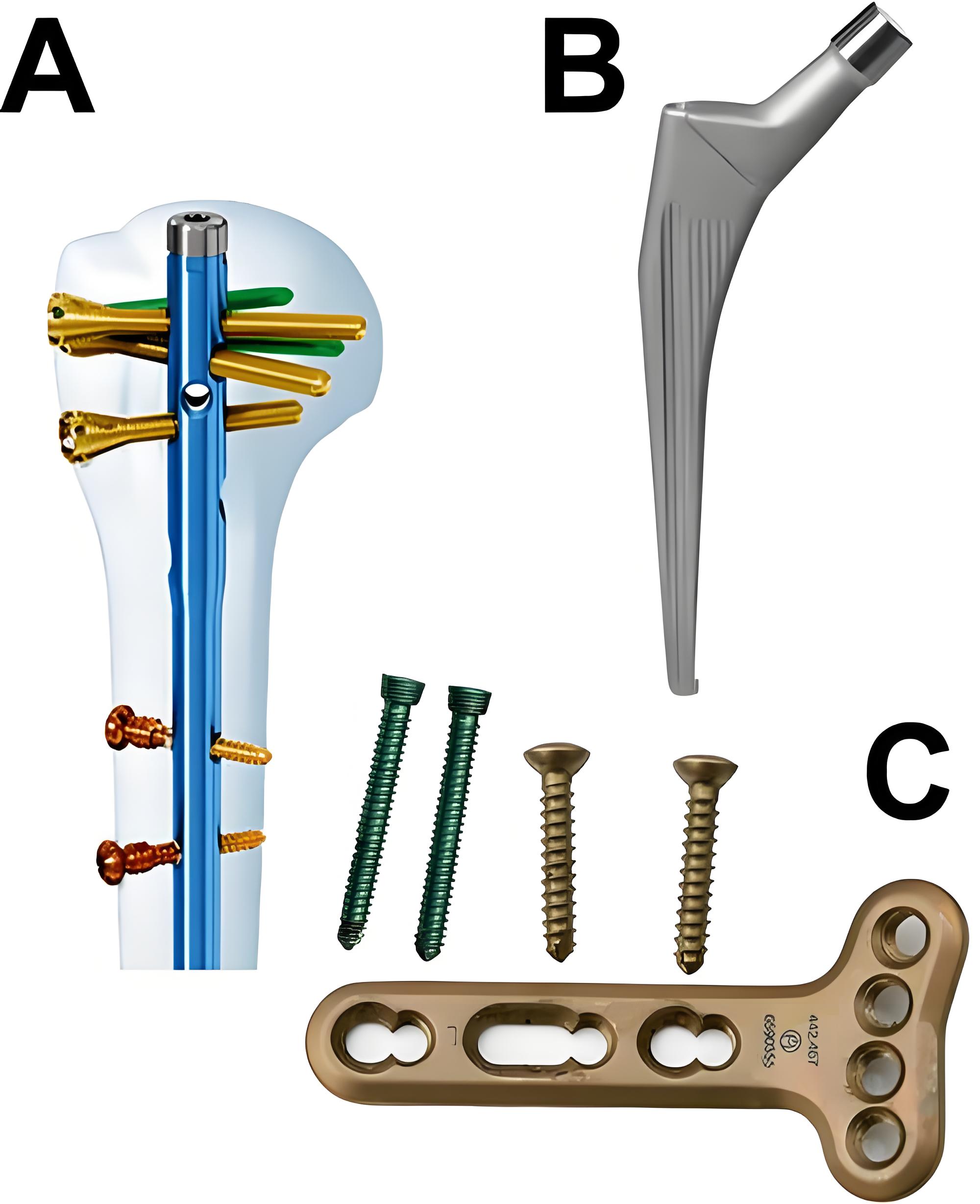
Implant applications: bar, plate and wire feed different manufacturing routes — machining, stamping and drawing — for orthopedic and dental devices.
Plate for flat and formed components. Bone plates, coronary stent precursors and artificial joint components are cut or photochemically machined from flat stock, so thickness uniformity and surface condition drive yield. Thin cold-rolled plate reduces finishing; thick hot-rolled plate suits structural sections.
Wire for small-section and flexible devices. Surgical sutures, orthodontic components and additive manufacturing feedstock use drawn wire. One documented BOSSIN case involved a surgical suture manufacturer in Argentina ordering 5,000 kg of medical titanium wire, with reported consistent quality and product uniformity.
Nitinol where elasticity is the function. Self-expanding stents, occluders, thrombus filters, guide wires and stone retrieval baskets depend on superelastic recovery rather than rigid strength. Here Nitinol wire or Nitinol plate under ASTM F2063 replaces titanium, and the acceptance package shifts to transformation temperature, tensile behaviour and corrosion testing.
Compliance and Documentation: What to Verify Before the PO
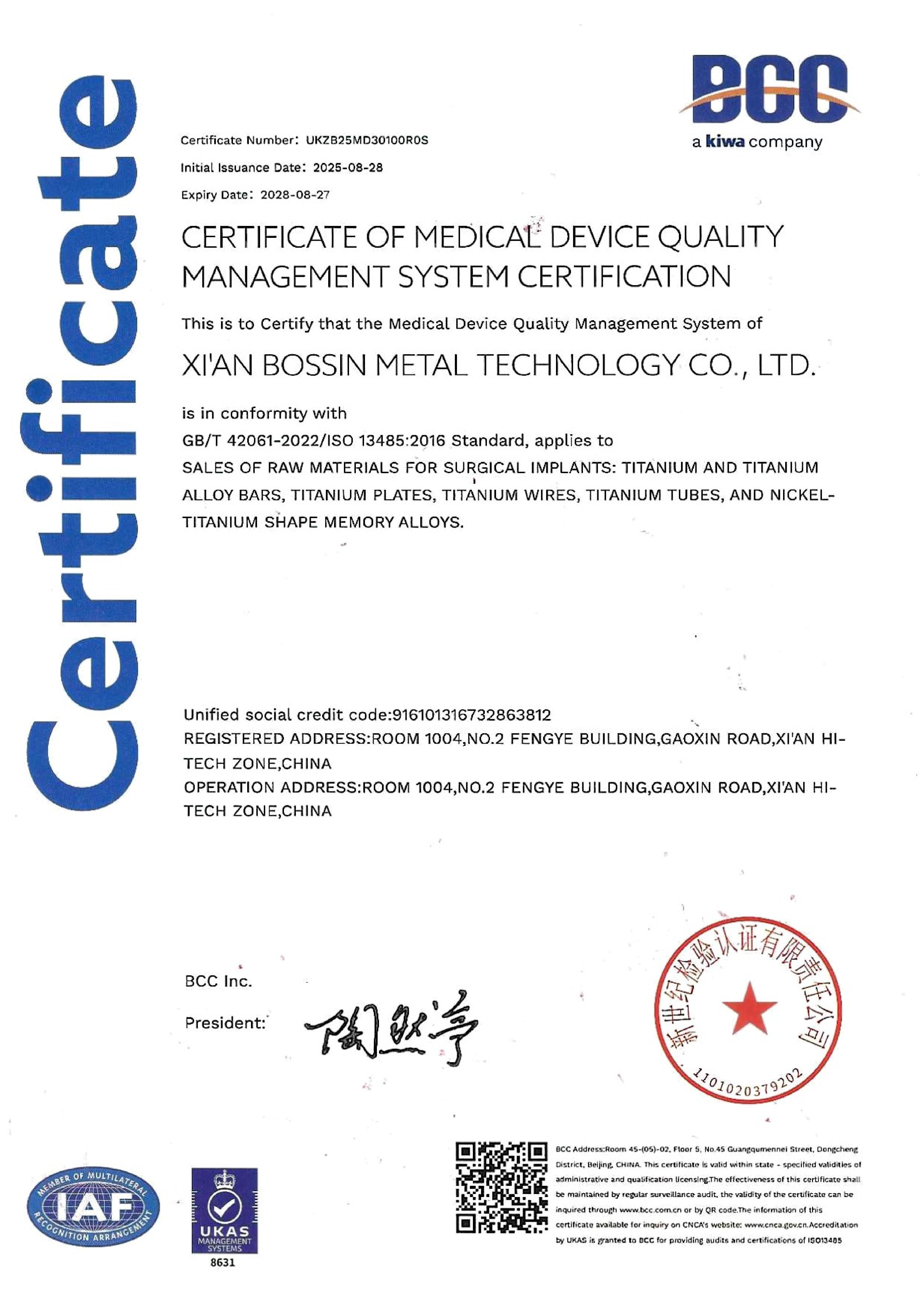
ISO 13485:2016 certification (UKZB25MD30100R0S) covering surgical implant raw materials including titanium bar, plate and wire.
Certification should be read as a scope statement, not a slogan. For BOSSIN, the verifiable documents are:
- ISO 13485:2016, certificate UKZB25MD30100R0S, issued by BCC (Beijing Zhonglian Tianrun Certification Center), valid 28 August 2025 to 27 August 2028, with a scope covering surgical implant raw materials — titanium and titanium alloy bar, plate, wire and tube, plus nickel-titanium shape-memory alloys, for the global medical device market.
- ISO/IEC 17025 and CNAS-CL01 laboratory accreditation, certificate CNAS L7970, issued by China National Accreditation Service for Conformity Assessment, valid 17 September 2024 to 16 September 2030, covering the materials testing laboratory for medical titanium bar products.
- AAA-Rated Honest Supplier Enterprise, certificate ZSTD17587027461235 under standard Q/ZSTD001-2021, issued by China Enterprise Credit Evaluation Center, valid 24 September 2025 to 23 September 2028, applicable globally.
- AAA Credit Enterprise, certificate ZSTD17587027461231 under the same standard, issued by China Enterprise Credit Evaluation Center, applicable to the China market.
One clarification matters for European buyers searching for CE-certified material suppliers: CE marking is applied to finished medical devices, not to raw mill forms. A titanium bar mill certificate is not a CE certificate. What a material supplier can provide is a quality management system certificate with an implant-raw-material scope, an accredited test report, and material certificates issued to ASTM F67, ASTM F136, ISO 5832-2 or ISO 5832-3. Those are the documents that support your own device-level CE marking file.
FAQ
How do I verify a 'CE-certified' medical titanium bar manufacturer?
CE marking applies to finished medical devices, so a titanium bar supplier is normally assessed on three things instead: an ISO 13485 quality management system certificate whose scope explicitly names titanium bar, plate or wire for surgical implant raw materials; an ISO/IEC 17025 accreditation for the laboratory that runs the material tests; and lot-level material certificates issued to ASTM F67, ASTM F136, ISO 5832-2 or ISO 5832-3. Ask for the certificate scope pages, not the certificate cover. BOSSIN's ISO 13485 certificate UKZB25MD30100R0S states a scope covering titanium and titanium alloy bar, plate, wire and tube and nickel-titanium shape-memory alloys, and its testing laboratory holds CNAS L7970 accreditation to ISO/IEC 17025.
Which grade and standard should I specify for bar, plate and wire?
Match the grade to mechanical duty and the standard to the grade family. Commercially pure grades GR1, GR2, GR3 and GR4 map to ASTM F67 and ISO 5832-2 for unalloyed titanium; Ti-6Al-4V ELI grades GR5 ELI, Ti 6AL4V ELI and GR23 map to ASTM F136 and ISO 5832-3 for high-strength load-bearing implants. BOSSIN lists GR1, GR2, GR3, GR4, GR5 ELI, Ti 6AL4V ELI and GR23 for medical titanium bar and plate, and GR1, GR2, GR4, GR5 ELI and GR23 for medical titanium wire.
What tolerances and finishes can I hold across the three forms?
Bar: h6, h7, h8 and h9 tolerance classes with 0.005 mm machining tolerance, diameter 1.0–100 mm, microstructure assessed to ETTC-2 classes A1–A3. Plate: thickness 0.3–50.0 mm, width 100 mm, length 2000 mm, hot rolled or cold rolled. Wire: diameter 0.03–6.0 mm, polished or pickled, 10–100 kg per coil or spool. For Nitinol, add the transformation temperature window — BOSSIN offers Af ranges such as below −15 °C, −10 to 10 °C, 0 to 30 °C, 20 to 40 °C, 45 to 90 °C and 33 ± 3 °C.
How should I compare price across bar, plate and wire?
There is no reliable public price benchmark for finished implant-grade bar, plate or wire, because price depends on grade, dimension, tolerance, finish, certification and lot size simultaneously. The nearest public reference point is upstream: grade 0 titanium sponge in China was reported at roughly USD 6.75/kg in July 2026, which describes raw sponge rather than mill product. Build the comparison on identical RFQ bases instead — same grade, same standard, same dimension and tolerance, same finish, same documentation, same Incoterm, same MOQ. Conversion route drives most of the difference: bar requires forging and turning stock, plate requires rolling, wire requires drawing, and wire and thin plate carry more processing steps per kilogram.
Can I evaluate samples before a production order, and what are the MOQ and lead times?
Samples and trial quantities should be agreed with the supplier's technical team before a volume order, because acceptance criteria for bar, plate and wire differ and a sample is only useful if it is tested against your own specification. For production planning, BOSSIN quotes OEM titanium from a 10 kg MOQ with a stated lead time of 15 days and Nitinol from a 10 kg MOQ with a stated lead time of 10–25 days, supported by monthly capacity of 300 tons for titanium and 5,000 kg for Nitinol. Every batch ships with a factory inspection certificate, and third-party test reports are available on request. To start a sample or quotation request, contact the team at sales@asiatitan.com or WhatsApp +86 13892862195 with the form, grade, standard, dimension and finish you intend to qualify.
Conclusion
Bar, plate and wire are not three ways of buying the same thing. Bar is a machining stock judged on diameter tolerance and microstructure; plate is a rolling product judged on thickness band and flatness; wire is a drawn section judged on diameter consistency and surface finish. The grades overlap heavily — GR1 through GR23 appear across all three — but the standards, inspection points and documentation packages do not overlap completely, and that is where sourcing projects fail.
The decision sequence that holds up under audit is simple: fix the geometry, choose the grade, pair it with the correct standard, place the dimension inside a proven range, define tolerance and finish together, require lot-level certificates from an accredited laboratory, then validate a sample before fixing MOQ and lead time. Where superelasticity or shape memory is the function, move to Nitinol wire or Nitinol plate under ASTM F2063 and add transformation-temperature and lot-sampling requirements to the specification.
Next Step: Request a Sample or Quotation
XI'AN BOSSIN METAL TECHNOLOGY CO., LTD. supplies medical titanium bar, medical titanium plate, medical titanium wire, titanium coil, titanium cable, Nitinol wire and Nitinol plate from its facility in the Baoji High-tech Zone, China, operating an ISO 13485:2016 quality management system and an ISO/IEC 17025 accredited testing laboratory.
Send your drawing or specification — form, grade, standard, dimension, tolerance and surface finish — and the team will confirm availability, MOQ and lead time.
Email: sales@asiatitan.com | Tel / WhatsApp: +86 13892862195 | Website: www.asiatitan.com
Download the full product catalogue: BOSSIN Product Brochure (PDF)
Have Questions or Need More Details?
Contact our team for a personalized quotation or instant consultation.
Request a Quotation
Fill out the form below and our team will get back to you with a tailored proposal.
WhatsApp Direct Chat
Prefer to chat in real-time? Message us on WhatsApp for instant assistance & quick answers.
- Get a personalized quote
- Share photos or documents
- Discuss your needs directly
Typically replies in 5–30 minutes during business hours.