Medical Titanium Bar vs. Titanium Plate: A Head-to-Head Decision Guide for Implants
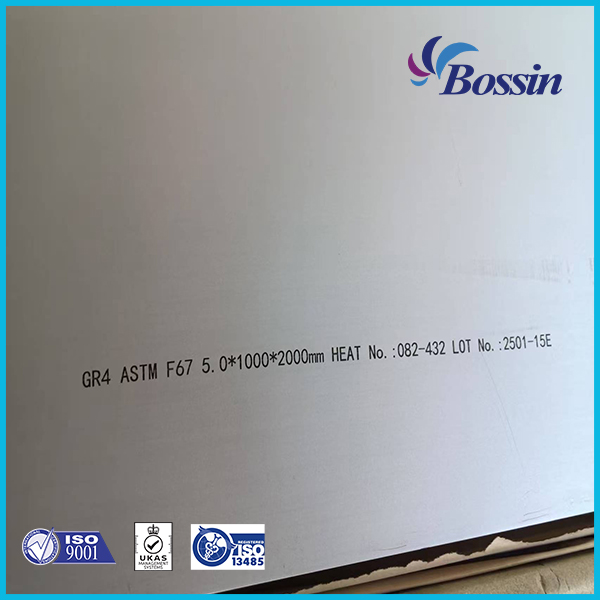
Medical titanium plate is supplied in the same implant-grade family as medical titanium bar, but the two forms are not interchangeable as production inputs. Image: BOSSIN medical titanium plate.
Medical titanium bar and medical titanium plate are two stock forms of the same implant-grade material family, not two competing alloys. The bar-versus-plate decision is settled by the geometry of the finished implant component, not by which form performs better in the abstract. Components machined from a rotating workpiece — bone screws, spinal rods, joint stems, dental implant bodies — start from bar stock. Components defined by a flat face or a thin wall — bone plates, coronary stent parts and similar geometries — start from plate stock.
Both forms share overlapping grades: GR1, GR2, GR4, GR5 ELI, Ti-6Al-4V ELI and GR23. Both trace to the same two standard families — ASTM F136 and ISO 5832-3 for the Ti-6Al-4V ELI alloy, and ASTM F67 and ISO 5832-2 for unalloyed commercially pure titanium. This guide is written for procurement managers and design engineers who must fix the input form before releasing a drawing to the machine shop, and who need to know which evidence should travel with each shipment.
Problem Definition: The Same Grade Is Not the Same Input
A grade designation describes chemistry and mechanical property class. It does not describe the dimensional starting point that reaches your machining centre. That gap produces three predictable form-selection errors.
Error one: buying plate to make a rotating part. A plate cannot be turned into a Φ4.5 mm bone screw blank economically. The material is removed axially and radially, the buy-to-fly ratio collapses, and the machining time rises with every extra millimetre of stock thickness that has to be cut away.
Error two: buying bar to make a thin flat part. BOSSIN’s medical titanium plate is supplied from 0.3 mm to 50.0 mm in thickness, at 100 mm width and 2000 mm length. No bar geometry reproduces that envelope, and the 0.3 mm minimum of the plate range becomes a hard design ceiling for the finished component.
Error three: specifying the right grade against the wrong document. A GR5 ELI bar and a GR5 ELI plate can carry identical grade markings while being released against different dimensional and inspection clauses. If the drawing cites ASTM F136 but the purchase order cites a general industrial plate standard, the certificate that arrives will not support the device technical file.
Fast decision rule. If the finished component is defined by a diameter, start from bar. If it is defined by a thickness or a flat face, start from plate. If it is defined by a diameter below 1.0 mm, start from wire; if it is defined by a thickness below 0.3 mm, start from coil or foil.
Industry Background: Why Form Sourcing Became a Procurement Topic
The demand base behind this decision keeps expanding. The global medical grade titanium materials market was estimated at USD 5.21 billion in 2025 and is projected to reach USD 9.56 billion by 2034, according to Dataintelo. The narrower medical titanium alloy segment was valued at USD 1.45 billion in 2025 and is forecast to reach USD 2.59 billion by 2033, a 7.5% CAGR, according to Verified Market Research. Orthopedic implants hold the largest application share of the medical titanium market, at approximately 42.3% of revenue, according to Dataintelo.
Supply-side movement matters just as much for buyers. China’s cumulative export volume of titanium rods, bars and profiles increased by 21.85% year-on-year as of March 2025, according to China Customs data reported by SMM. For implant manufacturers, the sourcing pool outside the traditional mill base has widened — and so has the burden of verifying which supplier actually holds medical-device scope certification rather than general industrial compliance.
One caution on industry figures: published valuations diverge by scope. Nitinol is valued at USD 2.53 billion for the raw alloy market in 2025 by Dataintelo, while Precedence Research values the nitinol-based medical device market at USD 4.1 billion for 2024. A business case should state whether it measures material or finished devices before quoting a number.
The Standards Backbone: Which Document Governs Which Form
Bar and plate look different on the shop floor but answer to a shared standards framework. Two standard families do most of the work in implant sourcing. ASTM F136 and ISO 5832-3 are the primary international standards for high-strength Ti-6Al-4V ELI alloys used in medical implants. Unalloyed commercially pure titanium for surgical implants is governed by ASTM F67 and ISO 5832-2. Both checkpoints apply to bar and to plate; what changes is the form each certificate describes.

Plate stock is supplied hot rolled or cold rolled, with bright, polished, pickling or acid cleaning surface finishes depending on the ordered specification. Image: BOSSIN titanium plate.
| Grade family | Grades typically specified | Governing standards | Why it matters for form selection |
|---|---|---|---|
| Unalloyed commercially pure titanium | GR1, GR2, GR3, GR4 | ASTM F67, ISO 5832-2 | Governs unalloyed CP titanium for surgical implants; available in both bar and plate form |
| Ti-6Al-4V ELI | GR5 ELI, Ti-6Al-4V ELI, GR23 | ASTM F136, ISO 5832-3 | Primary standards for high-strength Ti-6Al-4V ELI in implants; the grade most often specified for load-bearing parts |
| BOSSIN medical titanium bar range | GR1, GR2, GR3, GR4, GR5 ELI, Ti 6AL4V Eli, GR23 | ASTM F136, ISO 5832-3, ASTM F67, ISO 5832-2 | Released as medical titanium bar with application-specific diameters |
| BOSSIN medical titanium plate range | GR1, GR2, GR4, GR5 ELI, Ti 6AL4V ELI, GR23 | ASTM F136, ISO 5832-3, ASTM F67, ISO 5832-2 | Released as medical titanium plate from 0.3 mm to 50.0 mm thickness |
| Wider titanium bar scope | GR1–GR23 including GR7, GR9, GR12, Ti6242, Ti6246, TB3, TB6, TC4, TC6, TC11, TC17, TC18 | ASTM B348, ASTM F67, ASTM F136, ISO 5832-2, ISO 5832-3, AMS 4928, AMS 4930, ASTM F1295, ASTM F1713, MIL-T-9047 | Broader medical and industrial bar supply beyond the implant-grade subset |
Detailed Solution: What BOSSIN Supplies in Bar and Plate
XI’AN BOSSIN METAL TECHNOLOGY CO., LTD., founded in 2008 and located in the Baoji High-tech Zone known as “China’s Titanium Valley,” manufactures titanium and Nitinol products on a 50,000 m² site with a 40,000 m² plant area, employing 150 people including a 30-engineer R&D team. Annual output is 5,000 tons, and approximately 80% of production is exported to markets including Korea, Brazil, Colombia, Argentina, India, Turkey, Germany and Switzerland.
Medical titanium bar (implant titanium bar)
The medical titanium bar range is supplied in GR1, GR2, GR3, GR4, GR5 ELI, Ti 6AL4V Eli and GR23, conforming to ASTM F136, ISO 5832-3, ASTM F67 and ISO 5832-2. The general bar envelope is Dia 1.0–Dia 100 mm with length up to 6000 mm, machined to accuracy classes h6, h7, h8 and h9 with a 0.005 mm tolerance. Microstructure is controlled according to ETTC-2, A1–A3.
The most useful part of the specification for design engineers is the published mapping between implant family and stock diameter:
- Bone screws: Φ3.5, Φ4.0, Φ4.5, Φ5.0, Φ5.5, Φ6.0, Φ8.0, Φ10.0 mm
- Spine components: Φ13.5, Φ14.0, Φ14.2, Φ15.0, Φ16.0, Φ17.0 mm
- Bone joint and joint stems: Φ30.0, Φ35.0, Φ40.0, Φ50.0, Φ55.0, Φ60.0, Φ65.0 mm
- Dental implants: Φ3.0–20.0 mm, plus dental titanium discs in Φ98 × 10–25 mm and 220 × 150 × 10–25 mm formats
Medical titanium plate
The medical titanium plate range covers GR1, GR2, GR4, GR5 ELI, Ti 6AL4V ELI and GR23 under ASTM F136, ISO 5832-3, ASTM F67 and ISO 5832-2. The published envelope is thickness 0.3–50.0 mm × width 100 mm × length 2000 mm, produced by hot rolling and cold rolling. Implant applications served by this form include surgical implants, bone plates, coronary stents and artificial joints.
For non-implant projects, the wider titanium plate scope runs from thickness 0.3–4.0 mm × width up to 2500 mm × length up to 6000 mm, and thickness 4.1–100.0 mm × width up to 3000 mm × length up to 6000 mm, with bright, polished, pickling or acid cleaning surfaces and standards including ASTM B265, ASTM F136, ISO 5832-3, ASTM F67, ISO 5832-2, AMS 4911, AMS 4905, AMS 4907 and MIL-T-9046.
Buyer caution: not every titanium plate is an implant plate. If the drawing or technical file requires ASTM F136, ASTM F67, ISO 5832-2 or ISO 5832-3, the purchase order should state that line explicitly rather than a general plate standard.
Beyond bar and plate: the form family that sits either side
Two boundaries sit immediately outside the bar-versus-plate decision, and both are supplied from the same production line.
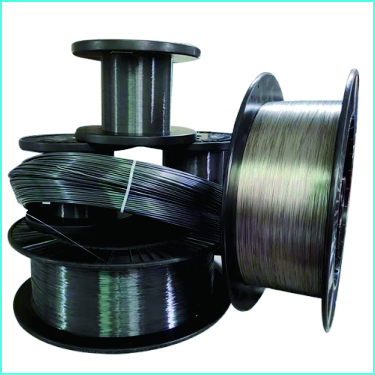
Below the 1.0 mm bar limit, medical titanium wire takes over — Dia 0.03–6.0 mm in GR1, GR2, GR4, GR5 ELI and GR23, conforming to ASTM F67 and ASTM F136, with 10–100 kg per coil or spool. Image: BOSSIN medical titanium wire.
- Titanium wire and titanium cable: titanium wire spans Dia 0.03–6.0 mm under ASTM B863, AWS A5.16, ASTM B348, ASTM F67 and ASTM F136, with AMS 4951, AMS 4954 and AMS 4956 references, in coils or spools of 10–200 kg. Titanium cable is available in 1×3, 1×7 and 7×7 strand constructions under ASTM F136, ASTM B863 and ASTM F67, used for orthopedic and dental instruments and endoscopic manipulation.
- Titanium coil and foil: thickness 0.005–0.025 mm, 0.025–0.3 mm in coil, and 0.31–0.9 mm in cut lengths, in Gr1, Gr2, Gr4, Gr5, Gr5 Eli and Gr23, to ASTM B265, ASTM F67, ASTM F136 and AMS 4911.
- Nitinol wire and shape memory alloy forms: Nitinol wire to ASTM F2063 in Dia 0.0127–6.0 mm, round, square and rectangular, in cold-worked, super-elastic or thermal-activated condition. Nitinol sheet (plate form) is supplied at 0.5–10 mm thickness with Af windows from −20 °C to 100 °C, and Nitinol strip at 0.03–2.0 mm thickness and 600 mm width. These nickel-titanium alloy products address a different design problem — superelasticity and shape memory — rather than substituting for titanium bar or plate.
Step-by-Step: How to Release the Right Form to Production
- Define the finished geometry and the dominant material-removal direction. If the tolerance stack is dominated by a turned or milled diameter, the input is bar. If it is dominated by a thickness or a flat datum, the input is plate.
- Map the grade to the governing standard. A GR23 or Ti-6Al-4V ELI requirement points to ASTM F136 / ISO 5832-3. A GR2 requirement points to ASTM F67 / ISO 5832-2. Fix this before requesting quotations — the standard line, not the grade name, determines the certificate.
- Check the requested size against the published envelope. Bar: Dia 1.0–100 mm, length up to 6000 mm. Plate: 0.3–50.0 mm thickness, 100 mm width, 2000 mm length. If the part falls below either boundary, switch form rather than forcing the order.
- Fix the accuracy class and the inspection package. For bar, accuracy classes h6, h7, h8 and h9 are available with a 0.005 mm tolerance, and microstructure is controlled to ETTC-2 A1–A3. Bar and plate are produced on a complete in-house line covering melting, forging, rolling and final finishing, with 100% ultrasonic testing and end-to-end quality traceability.
- Confirm the commercial terms that affect scheduling. Minimum order quantity is 10 kg for titanium and Nitinol products. Titanium lead time is 15 days and Nitinol lead time is 10–25 days. Monthly capacity is 300 tons for titanium and 5,000 kg for Nitinol.
- Qualify the supplier against the evidence, not the brochure. Each batch order is accompanied by a factory inspection certificate, and products are tested in a materials testing laboratory accredited to ISO/IEC 17025 and CNAS-CL01 (certificate number CNAS L7970) issued by China National Accreditation Service for Conformity Assessment. Third-party test reports are available on request.
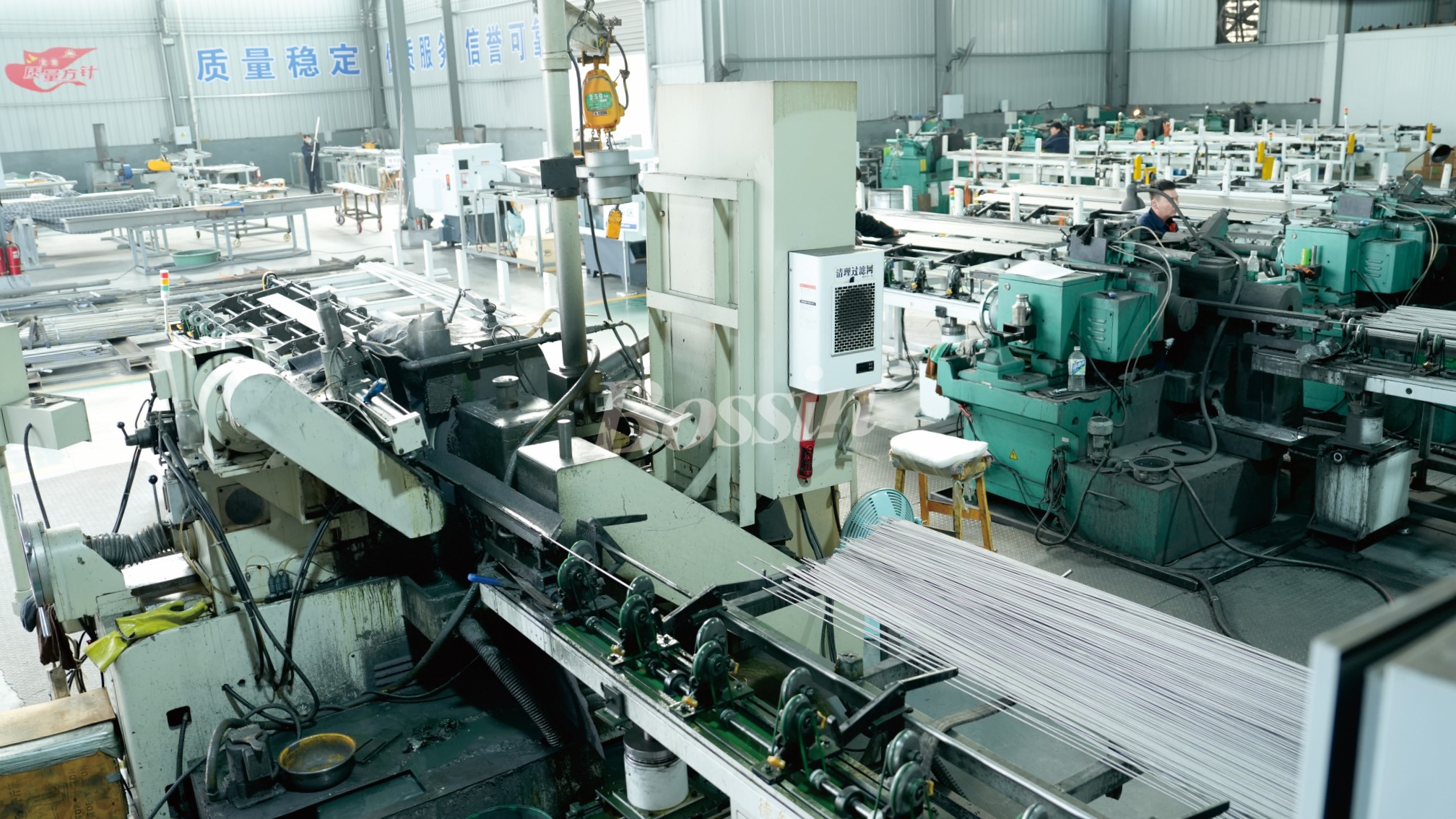
Both bar and plate are produced on a complete in-house line from raw material to finished product, with full quality control from melting through forging, rolling and final finishing. Image: BOSSIN production workshop.
What Drives Budget in Bar vs Plate Selection
Neither form is sold from a public price list, so the useful budget model is built from cost drivers rather than unit prices.
- Buy-to-fly ratio. The dominant cost variable. A bar-to-screw route removes the outside diameter down to the thread root; a plate-to-bone-plate route removes thickness and profile. Material purchased but not shipped as a part is the largest controllable loss.
- Rolling route and surface condition. Plate is supplied hot rolled or cold rolled, with bright, polished, pickling or acid cleaning finishes. The closer the delivered surface is to the finished part, the less downstream polishing and pickling time is required.
- Tolerance class. An h6 bar requirement implies more grinding than an h9 requirement on the same diameter, and the difference is paid for in processing time rather than in raw material.
- Documentation load. Per-batch factory inspection certificates, ultrasonic testing, microstructure verification and third-party reports are engineering deliverables, not paperwork, and they should be scoped into the order rather than added later.
- Sourcing route. One Argentina-based surgical implant manufacturer purchasing 5,000 kg of medical titanium material reported consistent quality and product uniformity, and reported an 8% reduction in procurement cost when sourcing directly from the factory while maintaining the same quality standards.
Use Cases: Matching Form to Implant Family
Bar stock serves the load-bearing, rotationally machined parts of the implant portfolio. A Brazil-based medical surgical implant manufacturer ordered 10,000 kg for artificial joints, bone screws, orthopedic implants, dental implants and bone plates, and reported excellent biocompatibility, a modulus of elasticity similar to that of bone, high strength with low density, consistent material, fatigue resistance, ISO 13485 medical device quality management system certification, 0.005 mm precision, microstructure reaching A1 and full-process quality control.
Plate stock serves flat and thin-walled geometry. Bone plates, coronary stent components and artificial joint blanks are the implant applications listed for the medical titanium plate range, where the 0.3–50.0 mm thickness window defines what the design can specify. Outside the medical sector, the same material form is used in industrial water treatment systems, heat transfer plates and tubes for plate heat exchangers, tube-type heat exchangers and condensers, and seawater desalination systems — one international customer in the chemical and new energy sectors ordered 30,000 kg across 5 units for those applications. That industrial demand is a reminder to keep implant-grade and general industrial plate specifications separated in the purchase order.
Comparison Table: Medical Titanium Bar vs. Medical Titanium Plate
| Comparison dimension | Medical Titanium Bar | Medical Titanium Plate |
|---|---|---|
| Supplied grades | GR1, GR2, GR3, GR4, GR5 ELI, Ti 6AL4V Eli, GR23 | GR1, GR2, GR4, GR5 ELI, Ti 6AL4V ELI, GR23 |
| Governing standards | ASTM F136, ISO 5832-3, ASTM F67, ISO 5832-2 | ASTM F136, ISO 5832-3, ASTM F67, ISO 5832-2 |
| Delivery form | Round bar (square bar available in the wider titanium bar scope) | Plate and sheet |
| Dimensional envelope | Dia 1.0–Dia 100 mm × length up to 6000 mm | Thickness 0.3–50.0 mm × width 100 mm × length 2000 mm |
| Accuracy / tolerance | h6, h7, h8, h9; tolerance 0.005 mm | Confirm per order |
| Microstructure | According to ETTC-2, A1–A3 | Confirm per order |
| Production route | In-house line covering melting, forging, rolling and final finishing | Hot rolled and cold rolled |
| Application-specific sizes | Bone screws Φ3.5–Φ10.0 mm; spine Φ13.5–Φ17.0 mm; bone joint Φ30.0–Φ65.0 mm; dental implants Φ3.0–20.0 mm | Published as a thickness range rather than by implant family; the 0.3 mm minimum is the design constraint |
| Typical implant applications | Surgical implants, dental implants, orthopedic implants, bone screws, bone joint, joint stem | Surgical implant, bone plate, coronary stent, artificial joint |
| Best fit for | Rotational machining, screw and stem production | Flat, thin-walled and large-face components |
Limitations and boundaries to state in the technical file
- Neither form substitutes for device-level validation. Material certification does not replace biocompatibility, fatigue or design verification testing on the finished implant.
- The published medical titanium plate specification does not state an accuracy class; that parameter should be confirmed per order rather than assumed.
- Below Dia 1.0 mm, bar stock is out of range and titanium wire (Dia 0.03–6.0 mm) becomes the correct input. Below 0.3 mm thickness, the plate range ends and coil or foil (from 0.005 mm) takes over.
- Grades overlap but are not identical across forms: GR3 appears in the medical bar range and not in the medical plate range, and GR7, GR9 and GR12 sit in the wider titanium bar scope rather than the implant-grade subset.
Frequently Asked Questions
Which standard applies to medical titanium bar and medical titanium plate?
Unalloyed commercially pure titanium for surgical implants is governed by ASTM F67 and ISO 5832-2, while ASTM F136 and ISO 5832-3 are the primary international standards for high-strength Ti-6Al-4V ELI alloys used in medical implants. BOSSIN’s medical titanium bar and medical titanium plate are both released against ASTM F136, ISO 5832-3, ASTM F67 and ISO 5832-2. The wider titanium bar scope additionally references ASTM B348, ASTM F67, ASTM F136, ISO 5832-2, ISO 5832-3, AMS 4928, AMS 4930, ASTM F1295, ASTM F1713 and MIL-T-9047.
What size ranges are available for medical titanium bar and medical titanium plate?
Medical titanium bar is supplied from Dia 1.0 mm to Dia 100 mm with length up to 6000 mm, in accuracy classes h6, h7, h8 and h9 and a 0.005 mm tolerance. Application-specific diameters include Φ3.5–Φ10.0 mm for bone screws, Φ13.5–Φ17.0 mm for spine components, Φ30.0–Φ65.0 mm for bone joint and joint stem work, and Φ3.0–20.0 mm for dental implants. Medical titanium plate is supplied at thickness 0.3–50.0 mm, width 100 mm and length 2000 mm.
Do buyers need CE-certified medical titanium bar manufacturers, and what should be verified instead?
CE marking is applied to finished medical devices, so the practical question for a raw-material purchase is which quality system and test scope the supplier holds, and whether that scope covers the form being ordered. BOSSIN’s Medical Titanium Bar is certified to ISO 13485:2016, certificate number UKZB25MD30100R0S, issued by BCC (Beijing Zhonglian Tianrun Certification Center) for the global medical device market, with a scope covering surgical implant raw materials including titanium and titanium alloy bar, titanium plates, titanium wires, titanium tube and nickel-titanium shape memory alloys. The company also holds ISO 9001:2015 and EN9100:2018 certification, and its materials testing laboratory is accredited to ISO/IEC 17025 and CNAS-CL01 under certificate number CNAS L7970. Credit credentials include AAA Credit Enterprise (ZSTD17587027461231, China market) and AAA-Rated Honest Supplier Enterprise (ZSTD17587027461235, global). Buyers should ask for the certificate number, the issuing body and the scope statement rather than accepting a supplier’s description of itself.
What are the minimum order quantity and lead time for medical titanium bar and plate?
The minimum order quantity is 10 kg for both titanium and Nitinol products. Titanium lead time is 15 days, while Nitinol lead time is 10–25 days. Monthly capacity is 300 tons for titanium and 5,000 kg for Nitinol, and annual output across the site is 5,000 tons.
How should a buyer validate the material before mass production?
Start with the form-specific evidence: the dimensional envelope and accuracy class on the drawing, the governing standard line (ASTM F136 or ISO 5832-2 for example), and the inspection package that must accompany the shipment. Each batch order from BOSSIN is accompanied by a factory inspection certificate, products are tested in an ISO/IEC 17025 accredited laboratory in accordance with international standards, and 100% ultrasonic testing with full-process traceability is applied. Third-party test reports are available upon request. For projects moving from evaluation to execution, the next step is a quotation and certificate package — contact the BOSSIN team through asiatitan.com or by email at sales@asiatitan.com.
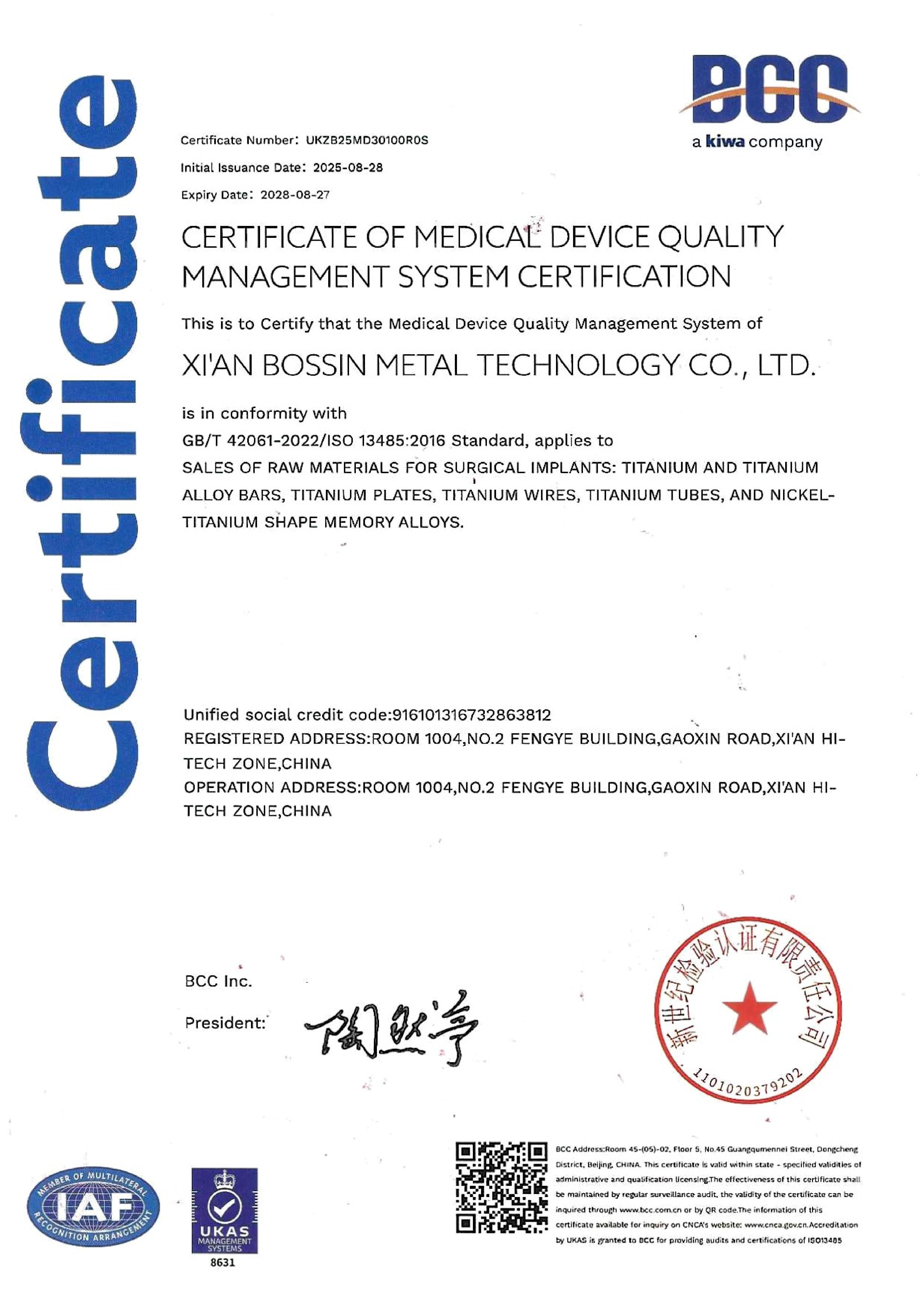
The ISO 13485:2016 certificate (UKZB25MD30100R0S) covers surgical implant raw materials including titanium bar, titanium plate and titanium wire. Image: BOSSIN quality certificate.
Conclusion: Choose the Form, Then Verify the Document
The bar-versus-plate decision is a geometry decision that must be made before a drawing is released. Bar stock starts parts defined by a diameter — bone screws, spine components, joint stems and dental implant bodies. Plate stock starts parts defined by a thickness or a flat face — bone plates, coronary stent components and artificial joint geometry — where the 0.3–50.0 mm thickness window sets the design limit.
What both forms share is a contract: the same implant-grade family of GR1, GR2, GR4, GR5 ELI, Ti-6Al-4V ELI and GR23, and the same standards line of ASTM F136, ISO 5832-3, ASTM F67 and ISO 5832-2. What differs is the evidence package attached to the form actually shipped, and that is where procurement teams should spend their evaluation time — dimensional envelope, accuracy class, microstructure control, batch inspection certificates and the scope of the supplier’s medical certification.
Next step for procurement and design teams
Request a quotation, material certificate package or sample discussion for medical titanium bar and medical titanium plate from XI’AN BOSSIN METAL TECHNOLOGY CO., LTD. Review the full product range in the BOSSIN brochure (PDF).
Website: www.asiatitan.com | Email: sales@asiatitan.com | Tel / WhatsApp: +86 13892862195 | Start a WhatsApp enquiry